Project · Reinforcement learning
Learn2Slither
Teaching a Snake to play on its own through trial and error and a handcrafted Q-table. A project at 42.
.zip — private GitHub repository, as required by 42
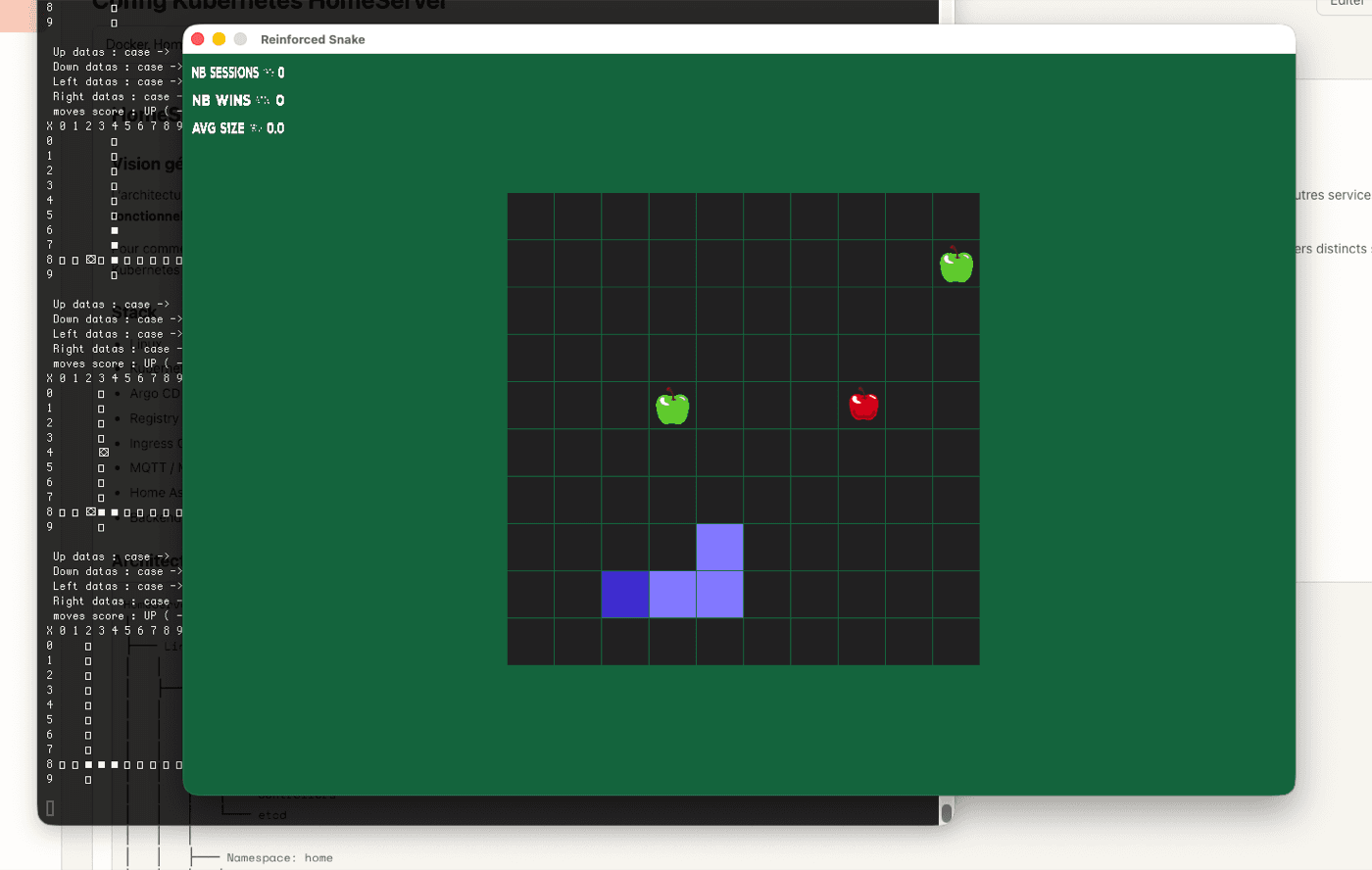
How the snake sees
No image, just four rays and a direction
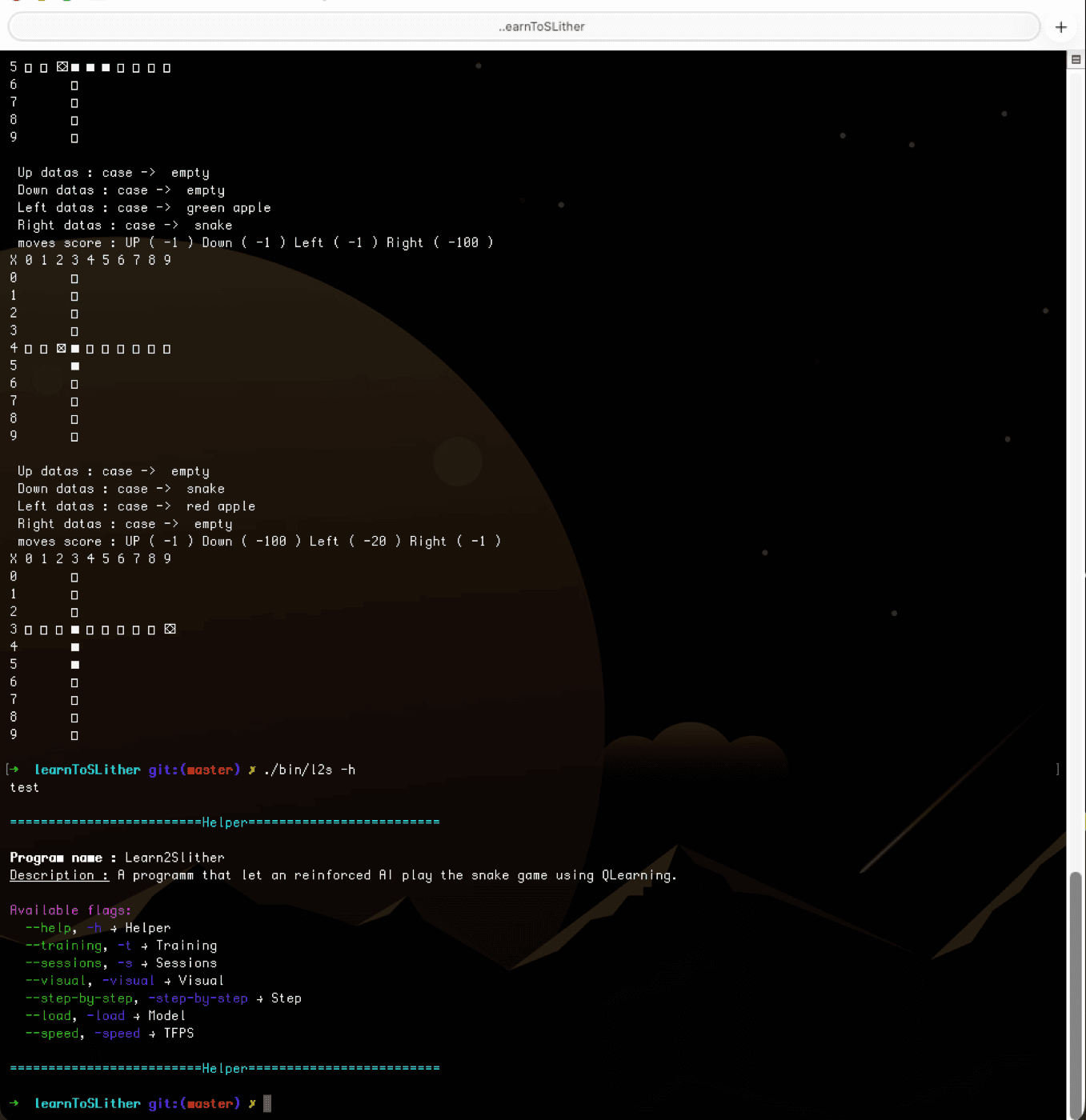
The snake does not see the board. On each turn, a ray extends from its head in each of the four cardinal directions until it finds a wall or its own body (W), a green apple (G), a red apple (R), or nothing (0). These four letters and the current direction form a short key such as "0G0WU", which is exactly the Q-table input. No neural network or combinatorial explosion: just a hash map that assigns a value to a situation.
Learning through rewards
A Bellman equation applied to every move
On every move, the expected value of the chosen action is compared with what it should actually have been worth (the immediate reward plus the best value reachable from the new position), and the Q-table is adjusted by the difference:
Q_observed = reward + γ · max(Q(next_state))
Q(state)  += α · (Q_observed - Q(state))

α = 0.1   (learning rate)
γ = 0.92  (discount factor)
To choose a direction, the snake samples from a softmax over the four values rather than using simple epsilon-greedy selection. A temperature of 2.65 encourages extensive exploration during the first 30% of training sessions, then drops to 1.25 to favor what already works. During normal play, outside training, a temperature sampled between 1.65 and 5.0 keeps things a little unpredictable.
Handcrafted from start to finish
The game had to be built too
The game engine
Snake, a 10×10 board, green and red apples, collisions: all the Snake logic was written before even thinking about AI.
The SDL3 interface
A small custom toolkit built on raw SDL3 (Screen, Board, Button, Text, Image), without Dear ImGui, and a bitmap font drawn one letter at a time.
The flag parser
A small command-line argument parser (--training, --sessions, --load...) written by hand instead of using getopt.
The Q-table is automatically saved at the end of each session in two formats: a compact binary for quick loading and a .st text file (one key value line per learned situation) for manual inspection.
On video
Watch the snake play
Command line
Train, then watch
./l2s -t -s 10000 --visual --speed 200      # train for 10,000 games
./l2s --load model-10000.s --visual         # replay a trained model
Tech stack
What powers Learn2Slither
- C++17Language, compiled with -O3
- SDL3 · SDL3_image · SDL3_ttfWindow, rendering, textures
- Custom Makefilepkg-config on macOS, vendored libraries on Linux
- Tabular Q-learningA hash map as the Q-table, no neural network